Blog
Assessment Evolved: Rethinking Formative Assessment Together in the Age of Generative AI

Meredith Reeve
Lead Specialist, Research Strategy, Pearson
Read the blog
Generative AI (GenAI) is no longer a distant prospect for education: it’s now a practical reality for schools. Pearson’s recently published research shows that 82% of secondary teachers in the UK say they’re at least ‘moderately familiar’ with GenAI, with the same proportion reporting the same for their students too. Understandably, such a landscape raises big questions about academic integrity, learning value, and what meaningful formative assessment should look like in the future.
For some teachers, the question is where to start. For others who are already experimenting with GenAI, it’s how to use it most effectively and responsibly in their classrooms. This wide range of experiences highlights the importance of the need and value of learning together – especially when it comes to evolving formative assessments.
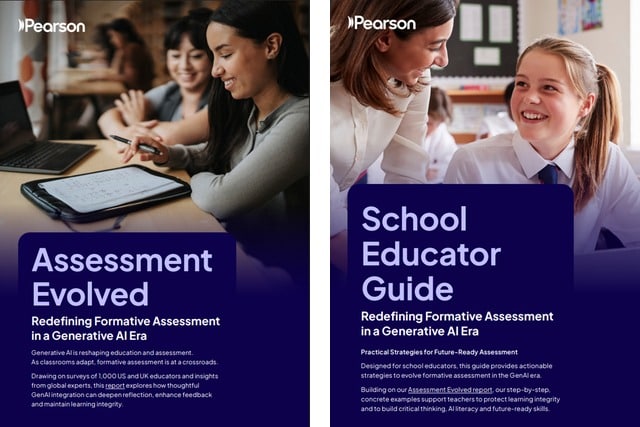
With this in mind, we set out to better understand teachers’ perceptions of how GenAI is impacting assessment in the UK and across the world, and to develop tools that could support teachers, students and leaders in this time of significant change. So, our Assessment Evolved research is informed by insights from more than 1,000 school and university educators and global experts in AI and assessment. What it reveals is a desire to retain learning integrity and to see formative assessment as a tool for growth in the GenAI era. And as we navigate what this could look like, we can see it as a unique opportunity to enhance assessments, deepen learning and build students’ AI literacy.
The now: formative assessment is at a crossroads
Ensuring GenAI strengthens reflection, feedback, and understanding will enable it to become a partner, rather than a substitute, for learning.
Rethinking and redesigning formative assessment with GenAI in mind will reinforce learning integrity and help build genuine student understanding in the long run. Together, we can identify where existing practices can evolve and build AI literacy for students and teachers alike.
Making this a reality: from insights to action
Every teacher’s, school’s, and student’s journey with AI is different. That’s why Assessment Evolved is accompanied by practical School Educator Guide, which outlines a number of tangible steps teachers can take to reflect on and evolve formative assessment – regardless of their level of experience and confidence with GenAI.
- Step 1: Have a clear purpose in mind
Every formative assessment should be clear on the knowledge, skills or thinking students are meant to demonstrate.
- Step 2: Define the assessment measures
Traditional tasks often reward outputs that GenAI can easily produce. Shifting emphasis towards deeper skills – such as reasoning, sense making and application – makes learning harder to bypass and more meaningful to assess.
- Step 3: Focus on process over product
To achieve this, we can shift focus from solely the final answer a student reaches to how they got there. Asking students to share drafts, explain decision points or reflect on revisions and their use of GenAI makes thinking visible and enables teachers to assess understanding, not just polished final responses.
- Step 4: Diversify assessment formats and modes
Using a mix of written, oral, visual, and practical assessment activities gives students multiple ways to show their learning. It also reduces over-reliance on a single task type that AI can generate quickly.
- Step 5: Add social and collaborative elements
Grounding GenAI usage in tasks such as discussion, peer feedback and group work anchor learning in interaction and shared reasoning, making it less solitary and more authentic to the teamwork students will encounter throughout their lives.
- Step 6: Include higher-order skills and processing
When asking students to use GenAI, provide opportunities for students to evaluate ideas, justify choices or apply ideas in context. This showcases students’ judgement and understanding that GenAI alone can’t replicate.
These are starting points on a journey that we as a sector can and should navigate together. By strengthening formative assessment and building shared understanding of how GenAI can be used as a catalyst for deeper learning, educators can continue to protect integrity, nurture understanding, and support every student’s growth, equipping them for a future in an AI-driven world.
And in the spirit of collaboration, Pearson would love to hear your thoughts on our Report and School Guide – and on how you’re adapting formative assessments in your school. Share your feedback with them at: [email protected].
Meredith Reeve is a Lead Specialist in Research Strategy at Pearson – one of HMC’s Corporate Partners. Drawing on 20 years’ experience across secondary teaching, assessment innovation, qualification development and product development, Meredith delivers high-impact research and thought leadership initiatives to advance learning and assessment across Pearson’s products and markets. She presented during the 2025 and 2026 Next Generation Assessment Conference’s Innovation Labs.
Date
27 February 2026
Share