Blog
Belonging as a Leadership Practice

Yasmina Koné
Hemisphere Education Deputy Lead
Read the blog
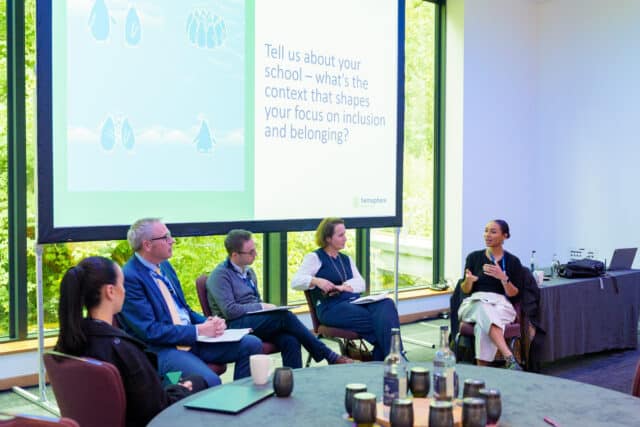 Belonging as a Leadership Practice: What School Leaders Can Learn from the HMC Autumn Conference 2025
Creating a genuine sense of belonging in schools is both essential and challenging. Leaders are tasked with fostering trust and inclusion amid increasing external pressures, from limited budgets to complex social dynamics.
At the HMC Autumn Conference, Hemisphere Education’s Deputy Lead, Yasmina Koné, sat down with Alan Bird (City of London School), Niamh Green (Roedean School) and Bradley Salisbury (Dean Close School) to discuss how schools can strengthen belonging in practical, sustainable ways.
Together, they reflected on what it means to lead with values during turbulent times and shared practical approaches to embedding belonging across their schools — for students, staff and communities.
Drawing on their insights, here are three key actions for school leaders navigating the complexities of belonging today.
- Lead with values when conversations become polarised
When complex or sensitive world events unfold, schools often find themselves at the centre of difficult conversations. Leaders must balance the need to protect psychological safety with the responsibility to engage with pupils’ questions and emotions.
Alan Bird, Head at City of London School, reflected on this balance:
“When there are divergent views, the most important thing is to unite everyone around a clear set of school values. That’s how we create community.”
By anchoring dialogue in shared principles — kindness, empathy, respect — leaders help pupils navigate difference constructively. This approach reframes belonging not as agreement, but as trust: trust in the school’s ability to accommodate for diverse perspectives safely.
Action:
Revisit your school values with your leadership team. Are they clearly understood, lived and referenced when challenging moments arise? Consider how those values can offer a common language for staff and students to explore difficult topics with confidence and care.
- Build staff confidence through reflective practice
Inclusion begins with a staff body who feel equipped and confident to engage with issues of identity and belonging. As Niamh Green observed, “training alone isn’t enough – staff need the right conditions to engage authentically.”
Privacy ensures psychological safety, and therefore deeper reflection on our own practice.
As Alan Bird noted, “so much INSET training happens in a hall, around tables, with people talking. In that kind of setting, when you’re discussing sensitive subjects, ‘survival brain’ can kick in and reflection can be limited. Staff value being able to engage privately, without fear, before having wider discussions.”
Building on this, Bradley Salisbury at Dean Close gave an example of how combining private reflection with open conversation deepened staff engagement with Hemisphere:
“Staff trained privately and then regrouped over lunch. During lunch, there was a genuine desire to talk about race equity; people were inspired. That mix of privacy and shared space was incredibly powerful.”
When done well, training can feel like an opportunity to reflect and connect, rather than an obligation during already busy schedules.
Action:
Create protected time for all staff to complete inclusion training privately, followed by group discussion. Encourage anonymous feedback. Create open, respectful environments where staff can share honestly without fear of judgment. This helps deepen trust and ensures reflection translates into meaningful change in practice.
- Turn belonging into a daily habit
Culture change happens when everyone, every day, makes small changes to their practice.
As Bradley Salisbury shared, “We’re more deliberate about representation across our whole school: in uniform policies, the curriculum, assembles, school displays. All those small things change the culture. It doesn’t happen overnight, but those moments add up.”
This visibility and representation is important. As Niamh Green shared:
“A parent told me their daughter chose Roedean because she saw a girl who looked like her on stage at Open Day and said, ‘I want to be like her’. Now we’re intentional about who appears on stage – can every pupil see a role model that represents them?”
Belonging isn’t an abstract goal; it’s felt in every interaction, every display, and every message of recognition that a pupil receives.
Action:
Audit the small, everyday moments that shape belonging. From assemblies to uniform codes, from classroom materials to staff role models. Ask: who is visible? Who is heard? What signals are we sending every day?
Why this matters now
Black History Month invites schools to reflect on representation, heritage and inclusion – but the insights shared at HMC Conference are a reminder that belonging isn’t a seasonal focus.
Belonging is an everyday practice.
At its core, belonging is about trust: the trust that students’ voices will be heard, that staff will be supported, and that leaders will act with consistency and care.

Want to take your school’s next step?
Hemisphere partners with HMC schools across the UK to embed inclusion and belonging as everyday practice for every staff member, every student, every day.
Book a demo to explore how Hemisphere can support your school: https://www.hemisphereeducation.com/
The HMC Corporate Partnerships programme connects HMC Heads and their staff with a variety of suppliers and professional advisors to independent schools both nationally and internationally. To find out more about our Corporate Partners, including Hemisphere Education, please visit the HMC School Leaders’ Directory, here. Alternatively, please email HMC Corporate Partnerships Manager, Rebecca Murphy, at [email protected]
Date
16 October 2025
Share