Blog
Lineage & Legacy

Nick Hope
Product Innovation Manager, RM Assessment
Read the blog
I have a prediction. It’s not my prediction, but you need to hear it:
Within the next ten years, there won’t be any more books in schools. None. The reason might surprise you, but it turns out that the ‘motion picture’ (television or streaming media, I guess) can be used to teach every branch of human knowledge.
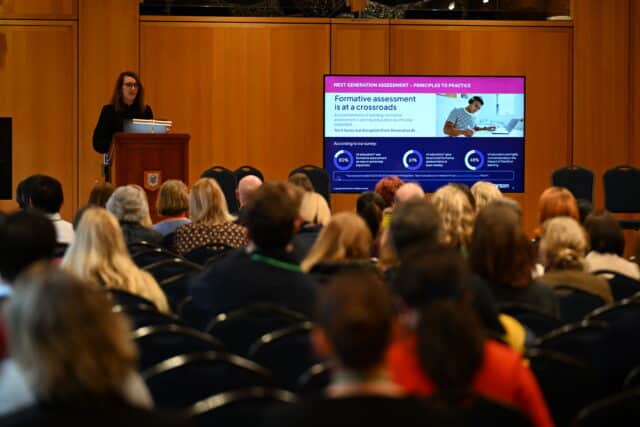
Thomas Edison famously shared this prediction in 1913 and I’m sure that it had absolutely nothing to do with the fact that he’d invested quite heavily in producing educational films for the classroom. I shared this prediction in the opening slide of a presentation at the 2026 Next Generation Assessment Conference in London and I’m sure I caught at least a couple of chuckles in the audience!
The point that I was trying to make is that throughout the history of education technology, there have always been bold and optimistic claims about how new tech is going to impact the teaching, learning, and assessment experience. As with most things in life, it’s only with hindsight that we’re really able to evaluate these claims properly. But what we can do is use this extensive lineage to give us some context. It might help us to keep our feet firmly on the ground when faced with promises like:
“No more teacher admin, ever”
or
“Just download your education straight into your neocortex”
Both of those are real claims by the way. In one of the presentations after mine, focusing on metacognition and ‘dual process theory’ Dan Bray from Cambridge University Press & Assessment explained why the idea of downloading information directly into our brains was anathema to how learning actually occurs. I couldn’t agree more! So how much of what we hear is grounded in reality and how much is just hype?
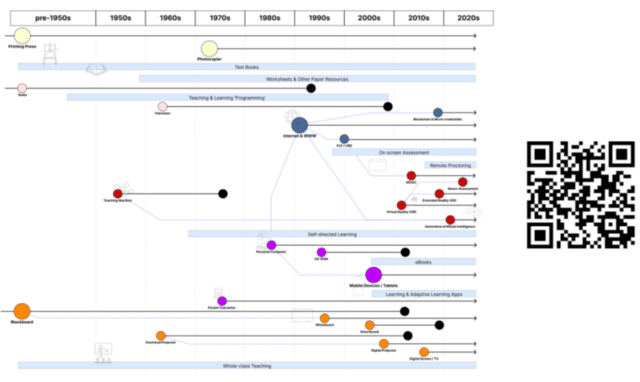
Like a lot of the speakers at the conference, I talked about AI. My view is that AI is part of this broader lineage and, like most other technologies from the past, is part of the legacy of its predecessors: the personal computer and mobile devices to make use of AI, the internet to get at it, and so on.
Some of these ‘technology ancestors’ are less obvious and I shared what I know about B.F. Skinner’s ‘Teaching Machine’. Check out my selective ‘lineage’ and share what you think I’ve missed via the QR code:
So, at 8:30AM, in front of a couple of hundred delegates and whilst trying really hard not to refer to it as “B.F. Teacher’s Skinning Machine” (likely raising some serious concerns about RM’s innovation roadmap), I talked about this fascinating mechanical device from the 1950s:
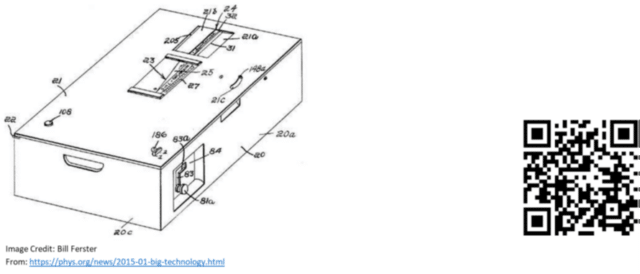
Specifically, I put forward the idea that it shares some ‘DNA’ with how AI is being used to affect the experience of learners today. Students answered questions on the device, got instant feedback, and experienced an (albeit rudimentary) adaptive learning experience. Pedagogy aside, this machine was a bit like the Duolingo of its day. It was an impressive piece of technology in its time and at its ‘peak hype’ some predicted that it might even replace teachers altogether!
Like Edison’s prediction about television replacing books, Skinner’s ‘Teaching Machine’ is a great example of how we can get a little caught up in the hype sometimes.
Personally, I think AI has a lot of potential to impact education positively. The general sense that I got from talking with delegates and listening to the other speakers was that most technologists and educationalists share this view but urge caution when it comes to protecting the value and efficacy of teaching, learning, and assessment.
Although I think we’re likely to see a ‘resetting’ of our expectations around AI over the next year, I think it will find its place. After all, the ‘television on wheels’ was a mainstay of my education AND I had plenty of books too. So Edison wasn’t entirely wrong.
My conclusions were broad: we don’t know what ‘shape’ AI will ultimately end up in within education but my view is that any new technology must satisfy at least four broad criteria in order to avoid fading into obscurity alongside the ‘Teaching Machine’.
- It must demonstrate a relative pedagogical advantage – this was a real theme of the day as it turns out.
- If necessary, we’ll need to adapt existing curricula and modes of assessment to account for the impact of new tech – and that might be really hard to do.
- Practitioners are the ‘gatekeepers’ of the classroom and without their willingness to adopt, the tech won’t get traction – so the tech has to be ‘fit for purpose’.
- What happens outside education is intimately linked with what happens inside the classroom – ignoring new technology isn’t an option, whether we choose to embrace it or not.
In the last session of the day at the Next Generation Assessment Conference, panel members were asked if they were excited or nervous about AI in schools. It was a mixture of both, and I think that’s exactly how we should be feeling.
One thing is for sure – what happens next is going to be fascinating!
Date
3 March 2026
Share