Blog
Small Hands, Big Systems

Daniel Woolley
Junior School Teacher / Sustainability Lead, Dulwich College Singapore
Read the blog
Building Environmental Purpose Across a School Community
One of the most powerful sustainability conversations I have had with a child started with a very ordinary question: ‘What happens if one person saves one small piece of food from being wasted every day?’
At first, the answer feels simple. Not much. It is only a small portion of rice, a few vegetables or an unfinished snack. But when children multiply that choice across a class, a year group, a school and an entire academic year, the conversation changes. Suddenly, sustainability is not abstract. It is visible, mathematical, ethical and most importantly, part of daily life.
That is the space schools need to occupy more deliberately. Climate action cannot sit only in assemblies, events or display boards. Those moments matter, but they are most powerful when they are part of a wider culture: one where children are helped to see the systems around them and understand that their choices sit within something bigger.
At Dulwich College (Singapore), we are on a journey to move sustainability from awareness to agency. The question is not simply, “Do children know about climate change?” Increasingly, the more important question is, “Do children understand the systems they are part of and do they feel able to shape them?”
One example has been No Carbon November, a month of daily challenges designed around the idea of ‘Teaspoons of Change’: small actions that become powerful when many people take part. Students were invited to choose lower-carbon travel, reduce food waste, support local businesses and share actions from home. The learning sits in the pattern: small choices, repeated across a community, build habits, conversations and shared responsibility.
This links closely to our wider school language. In DUCKS, our youngest children use the Learning Bugs to think about dispositions such as curiosity, care and resilience. In the Junior School, we build on this through the College’s Guiding Statements, the Global Goals and the Compassionate Systems Framework. Sustainability becomes part of what it means to think with the head, heart and hands: understanding complex systems, caring about the people and places within them, and taking practical action.
Our Junior School Sustainability Ambassadors have also played an important role. They have not simply been given tasks; they have been trusted with real questions. How do we explain circular economy thinking to younger children? How do we make waste visible without creating a culture of blame? How do we encourage action in a way that feels positive rather than performative? These are leadership questions and children are remarkably capable of engaging with them.
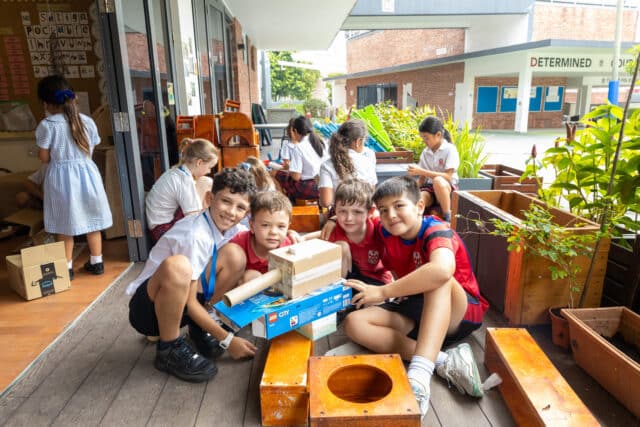
At Dulwich College (Singapore), the Greenhouse is our on-site recycling hub. Through House collection points, students collect suitable plastics, including bottle caps and other clean, dry materials. The Sustainability Ambassadors then help sort and prepare these before they are shredded and pressed into new, usable products such as clipboards, coasters and iPad stands. This is the circular economy in a form children can see, touch and explain. Plastic has a journey, a value and a second life.
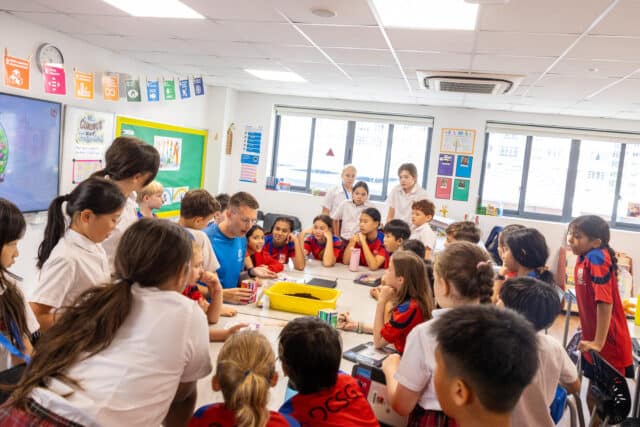
During Earth Week, we wanted children to experience that circular thinking in another everyday system: food. Working with Sodexo, our school catering partner, classes reused milk cartons and other suitable catering materials as planters. Children planted herbs in them, with the aim that what they grow can return to school food. It is a simple but powerful loop: waste becomes a container, compost supports growth and the produce has a route back into our community.
A key part of this work is Sustainable Snippets, a programme I have been developing to make sustainability learning more consistent across the Junior School. These short, low-preparation moments connect the Global Goals to real College data, helping children see how individual choices, school systems and global challenges are linked.
Partnership has been essential. Catering teams, operations colleagues, teachers, students, families and external organisations all see different parts of the system. When children learn about food waste, energy use, recycling, product choices or outdoor spaces through real examples, the learning carries more weight. They see adults trying, adjusting and sometimes wrestling with imperfect answers. That honesty is important.
World Environment Day is a useful moment to pause, but the real work is quieter and more regular. It is in the lunch queue, the classroom discussion, the recycling stations and the decision to try again when something does not quite work.
If schools want to lead the way to a sustainable future, we need to make sustainability visible, practical and shared. My challenge to other schools is to start with one system children already know well: lunch, waste, uniform, transport, energy or classroom resources. Make that system visible, invite students to improve it and let them see that change is something they can practise. Children do not need to wait to become changemakers. They can begin now.
Date
5 June 2026
Share